Fifty Years of Purchased Influence: What the FEC's Own Records Reveal About Corporate America's Hold on Washington
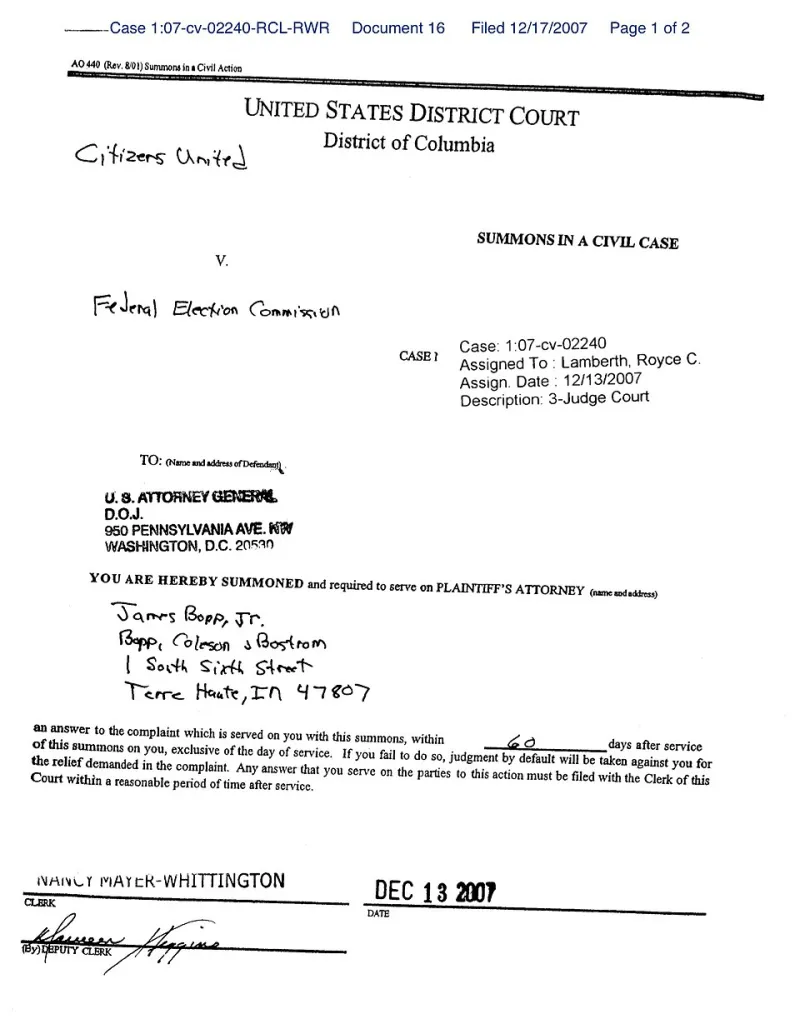
Photo: U.S. District Federal Court for the District of Columbia, Public domain, via Wikimedia Commons
There is a version of American democracy that exists in civics textbooks, and then there is the version that lives inside Federal Election Commission filing cabinets. The two bear only a passing resemblance to each other. For fifty years, the FEC has quietly accumulated one of the most consequential archives in the country — a granular, searchable ledger of who gave money to whom, when, and in what quantities. Most Americans have never looked at it. The corporations that benefit from their inattention are counting on that remaining true.
The Radical Database has spent months cross-referencing FEC contribution records, OpenSecrets aggregated data, and congressional voting histories to construct a longitudinal map of financial relationships between major industries and federal legislators. What emerges is not a conspiracy. It is something more mundane and, in many ways, more troubling: a system operating precisely as designed.
The Architecture of Access
The modern campaign finance apparatus did not materialize overnight. It was constructed incrementally, through a series of legislative and judicial decisions that each, in isolation, appeared modest. The Federal Election Campaign Act of 1971 created the disclosure infrastructure. The creation of Political Action Committees formalized the corporate giving pipeline. The Supreme Court's 2010 ruling in Citizens United v. FEC effectively removed the ceiling.
What the FEC data reveals, when examined across these distinct eras, is that the fundamental dynamic — industries concentrating financial resources toward legislators with jurisdiction over their regulatory fate — predates Citizens United by decades. The 2010 ruling did not invent the purchase of access. It industrialized it.
Between 1990 and 2023, pharmaceutical industry PACs and individual donors affiliated with major drug manufacturers contributed over $400 million to federal candidates and party committees, according to OpenSecrets data derived from FEC filings. That figure does not include so-called dark money routed through 501(c)(4) organizations, which are not required to disclose donors. The disclosed total alone is staggering. The undisclosed portion is, by definition, unknown.
Pharmaceuticals: The Regulatory Revolving Door
The pharmaceutical sector offers perhaps the most instructive case study in how sustained financial relationships translate into policy outcomes. In the years preceding the 2003 passage of the Medicare Prescription Drug, Improvement, and Modernization Act — legislation that explicitly prohibited Medicare from negotiating drug prices — pharmaceutical companies dramatically escalated their PAC contributions to members of the House Ways and Means Committee and the Senate Finance Committee, the two bodies with primary jurisdiction over the bill.
FEC records from the 2002 and 2004 election cycles show that members of those committees received, on average, 34 percent more in pharmaceutical industry contributions than their colleagues without committee assignments in the same period. This is not a coincidence. It is a documented pattern that repeats itself across industries and legislative cycles with the reliability of a financial instrument.
The drug pricing prohibition remained in federal law for nearly two decades. When the Inflation Reduction Act of 2022 finally granted Medicare limited negotiating authority, the pharmaceutical lobby spent over $380 million in a single year attempting to block or dilute it — the highest single-year lobbying expenditure in the industry's recorded history.
Finance and the Decade After Deregulation
The financial services sector presents a different but equally instructive timeline. FEC filings from the mid-1990s document a sustained, bipartisan campaign finance effort by major commercial banks and investment firms that directly preceded the 1999 repeal of the Glass-Steagall Act. That Depression-era law had separated commercial banking from investment banking for sixty-six years. Its repeal, through the Gramm-Leach-Bliley Act, was signed by a Democratic president and passed with broad support from legislators who had received significant financial industry contributions in the preceding election cycles.
The nine years between Glass-Steagall's repeal and the 2008 financial crisis represent one of the most consequential regulatory experiments in American economic history. FEC data from that period shows financial industry contributions to federal candidates averaging over $300 million per election cycle — a figure that dwarfs every other sector except, in certain cycles, real estate.
Following the 2008 collapse and the subsequent passage of Dodd-Frank financial reform legislation in 2010, the same institutions spent the following decade systematically contributing to legislators positioned to weaken the law's provisions. By 2018, the Economic Growth, Regulatory Relief, and Consumer Protection Act had rolled back significant Dodd-Frank requirements for mid-sized banks. FEC records show that the bill's Senate co-sponsors received, in aggregate, over $40 million from banking industry sources across their careers.
Defense: The Most Durable Investment in Washington
If pharmaceuticals demonstrate the power of concentrated giving and finance illustrates the long game of deregulation, the defense industry reveals something different: the near-perfect geographic distribution of financial relationships. Major defense contractors have, for decades, structured their manufacturing and subcontracting operations to ensure that production facilities exist in as many congressional districts as possible. This is not primarily a business decision. It is a political one.
FEC filings for the top five defense contractors — Lockheed Martin, Raytheon, Boeing, Northrop Grumman, and General Dynamics — show consistent, decades-long contribution patterns to members of the House and Senate Armed Services Committees. Between 2000 and 2022, those five companies contributed a combined total exceeding $200 million to federal candidates and party committees, with the plurality directed toward committee members regardless of party affiliation.
The result is a defense budget that has grown, in inflation-adjusted terms, in nearly every fiscal year since 2001. Congressional opposition to specific weapons programs is routinely neutralized not by lobbying arguments but by the simple fact that canceling a program means eliminating jobs in a colleague's district.
What the Archive Demands of Us
The FEC's public database is not a secret. It is freely accessible at fec.gov, searchable by donor, recipient, industry, and date. The data examined in this analysis is not classified or leaked. It is public record, filed under legal obligation, available to any citizen with an internet connection and the patience to navigate a federal database interface.
The question is not whether this information exists. It is why its existence has done so little to alter the underlying dynamics it documents. Part of the answer lies in the sheer volume of the archive — fifty years of filings represent a quantity of information that resists casual comprehension. Part of it lies in the normalization of campaign finance as a background condition of American politics rather than an ongoing structural scandal.
But the archive does not allow for comfortable conclusions. It is a ledger, and ledgers do not editorialize. They simply record what was exchanged, between whom, and when. The Radical Database will continue to make that ledger legible. The conclusions belong to the readers who engage with it.
All financial figures cited in this article are derived from Federal Election Commission public disclosure records and OpenSecrets.org aggregated campaign finance data. Primary source links are available in the database index.